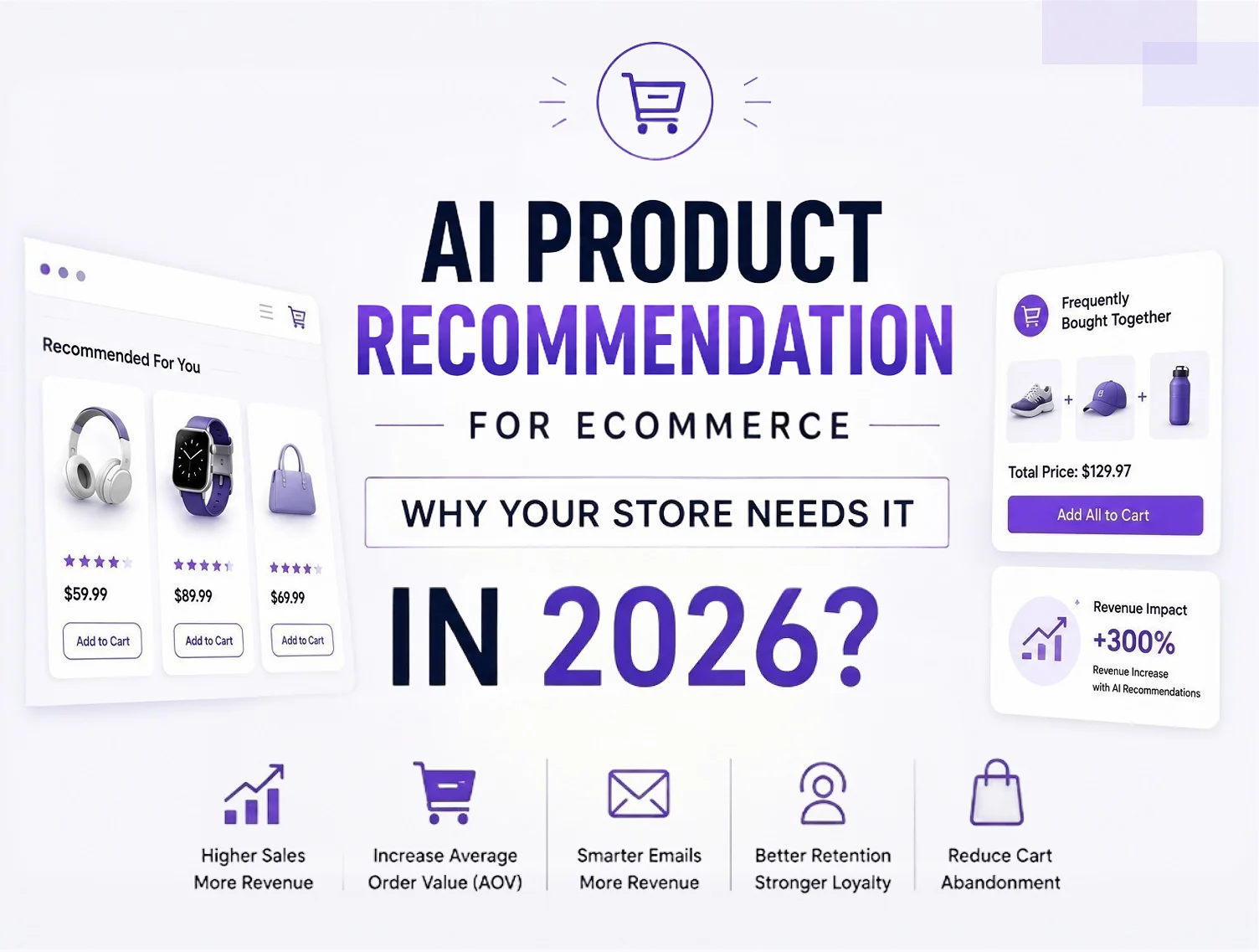
Imagine you’re walking down to a store, where all the shelves have been rearranged just for you, so you would know where to look, just to get your product. And that is what AI Product Recommendation for Ecommerce can do, throughout the entire world, for each and every visitor, all at once.
Let us provide you with a better explanation. If you would care to look at the recent findings of 2026, 71% of consumers are already expecting this kind of personalised shopping experience for themselves. So, it’s not a fantasy anymore, but an aspect on which people are already working!
So, that [AI product recommendations] would be today’s topic, which we will break out through the medium of this blog. And we’re also gonna talk about how it literally works, what benefits can come our way with it, and where companies should start with it in 2026.
What is an AI Product Recommendation for Ecommerce?
An AI product recommendation for ecommerce is a system that can analyze the very behavior of the shopper, as per the crucial info such as browsing history, past purchases, and real-time clicks.
And on the basis of these readings, AI will automatically suggest the most relevant products to those shoppers, at the right moment. It powers the “You may also like,” “Frequently bought together,” and “Customers also viewed” widgets that you already see on various leading ecommerce sites.
You’re not gonna believe the scale of impact, which is crazy hard to ignore. Amazon’s recommendation engine alone accounts for 35% of its total revenue. The same technology that once required enterprise budgets is now accessible to every Shopify and WooCommerce store.
The core difference from old-school “related products” widgets? Rule-based systems show the same static suggestions to everyone. AI recommendation systems adapt in real time, per shopper, per session, making every visit feel like AI ecommerce personalisation built specifically for that customer.
How does an AI Product Recommendation for Ecommerce Work?
Under the hood, AI product recommendation for ecommerce relies on three core approaches:
Collaborative Filtering
This is the most widely used method in collaborative filtering ecommerce systems. It groups shoppers with similar behaviour and recommends what others in that group bought or viewed. When Amazon says “Customers who bought this also bought…” that’s collaborative filtering at work. Netflix and Spotify use the same logic for content recommendations.
Content-Based Filtering
Instead of looking at other shoppers, content-based filtering looks at the product itself, its category, price range, attributes, and description, and recommends similar items. This method works especially well for new visitors who have no purchase history yet, solving what’s known as the “cold-start problem.”
Hybrid Models
Most modern AI tools combine both methods, layering in real-time session signals, what the shopper is clicking right now, how long they’re dwelling on a product, and what they’re ignoring. The result is far more accurate recommendations that improve continuously as more shoppers interact with the store.
5 Key Benefits of AI Product Recommendations for Ecommerce Stores
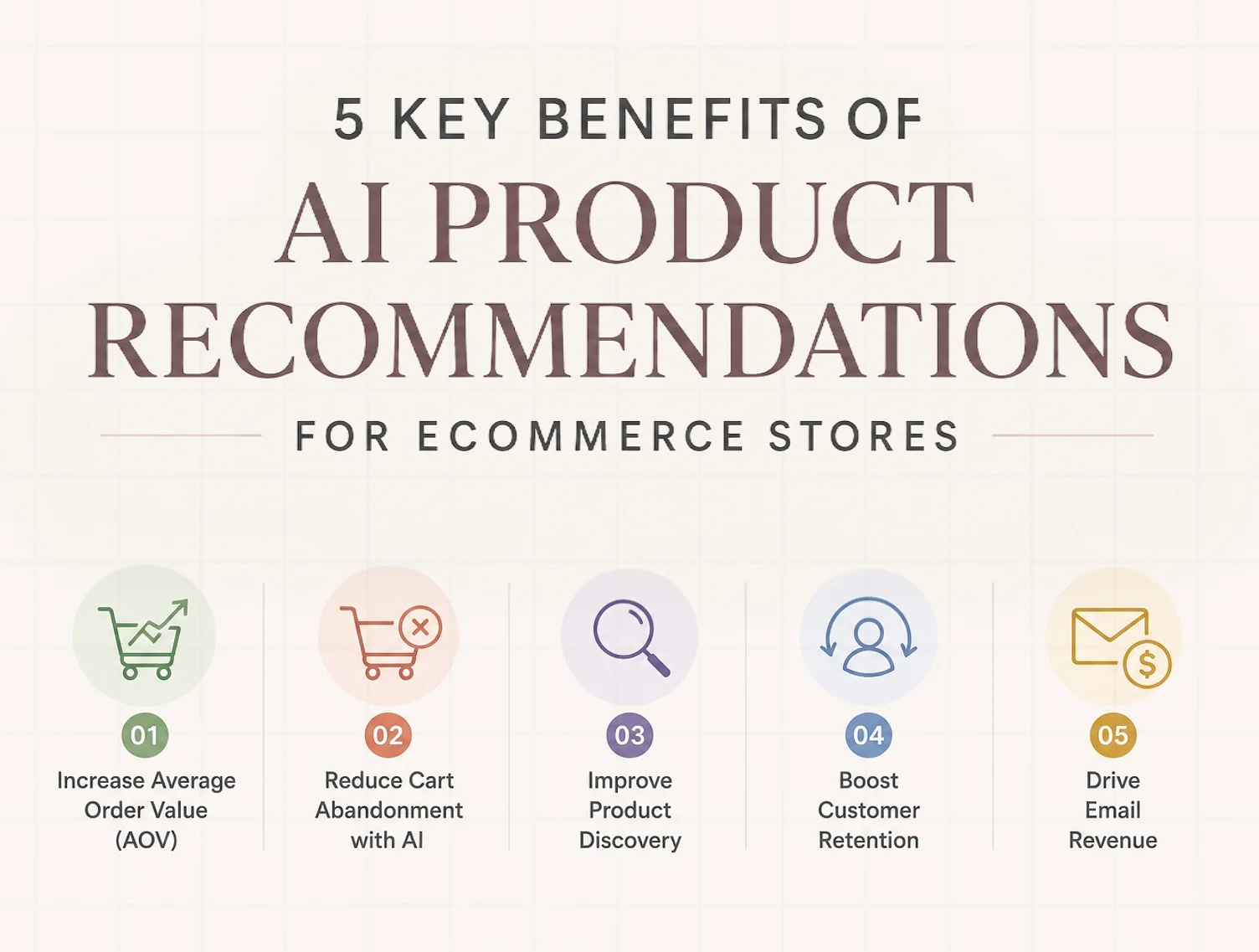
Understanding the benefits of a product recommendation engine goes beyond just showing relevant items. Here’s what AI product recommendations to increase sales actually deliver:
1. Increase Average Order Value (AOV)
When a shopper sees a complementary product at the right moment, on the product page or in the cart, they’re far more likely to add it. Stores using AI-powered styling recommendations have reported 70% higher AOV compared to their sitewide average.
2. Reduce Cart Abandonment with AI
Cart abandonment sits at nearly 70% across ecommerce. Reducing cart abandonment with AI works by triggering personalised recovery emails that don’t just remind shoppers they left, they show them the exact products they were interested in, or complementary items that sweeten the return.
3. Improve Product Discovery
Generic bestseller lists show the same 10 products to everyone. AI-powered “Top Picks” on the homepage, personalised to each visitor, have driven 11x higher product views per visit. Personalised product recommendations in ecommerce make your entire catalogue discoverable, not just your top sellers.
4. Boost Customer Retention
76% of shoppers are more likely to return to brands that personalise their experience. AI recommendations don’t just serve one visit; they evolve with the customer’s behaviour over time, making every return visit feel more relevant than the last.
5. Drive Email Revenue
Adding AI product recommendations to email flows isn’t a minor tweak. Companies that implemented dynamic product recommendations in their emails reported a 300% increase in revenue and a 50% increase in average order value, without increasing their send frequency.
Where to Use AI Recommendations in Your Store?
Placing personalised product recommendations across your ecommerce store at the right touchpoints is what separates a good implementation from a great one. Here’s where they work hardest:
Homepage: Show “Top picks for you” based on browsing history for returning visitors, and trending or bestselling items for first-timers. First impressions drive or kill engagement.
Product Pages: “You may also like” and “Frequently bought together” capture shoppers at peak purchase intent. This is where upsell and cross-sell do the heavy lifting.
Cart Page: The last touchpoint before checkout. Suggest complementary items that complete the order, accessories, add-ons, or bundles that make the cart feel incomplete without them.
Post-Purchase Emails: Dynamic recommendations that update based on what was bought and what was browsed. Not static suggestions, real-time, relevant, and timed right.
Abandoned Cart Flows: A generic “You left something behind” email converts poorly. An email that shows the exact product the shopper was viewing, or a similar alternative, converts far better.
This is what effective AI ecommerce personalisation looks like in practice: the right product, to the right shopper, at the right moment across every channel.
AI Recommendation Tools for Shopify and WooCommerce Stores
For AI tools for Shopify store owners, the ecosystem in 2026 is genuinely accessible, whether you’re just starting out or scaling an established store:
- Shopify Native: Shopify’s built-in recommendation widget and Shopify Magic offer content-based suggestions out of the box. Free, zero setup, and a solid starting point for stores just getting into personalisation.
- Rebuy Engine: A hybrid AI recommendation tool built specifically for Shopify. Handles smart cart upsells, post-purchase recommendations, and personalised homepage widgets with minimal setup.
- Nosto: A full personalisation platform that works across both Shopify and WooCommerce. Behavioural targeting, real-time recommendations across all pages, and deep segmentation for growing stores.
- LimeSpot: Lightweight and beginner-friendly. A good entry point for small-to-mid Shopify stores that want AI recommendations without the complexity of an enterprise tool.
- WooCommerce: The Frequently Bought Together plugin covers the basics. For more advanced ML-powered recommendations, Nosto and Clerk.io both integrate cleanly with WooCommerce setups.
Start with what’s already built into your platform, measure the results, then layer in more powerful tools as your data and traffic grow.
Conclusion
AI product recommendation for ecommerce is not a luxury anymore, for the brands throughout the world, but a necessity, to ensure a more user-friendly experience for their users. Because every company today seeks the highest-ROI personalisation tool available in the market, whether it’s a Shopify or WooCommerce store, regardless of their size or budget.
And the stores winning right now aren’t the ones having the massive catalogues or the largest ad spends, but are the ones that make every shopper feel like the store was just built for them.
So, whenever you want to build a smarter and faster ecommerce experience for your customers, you should find an expert like Dynamic Dreamz. A company that can specialise in Shopify and WooCommerce development.
FAQ
What is an AI recommendation system for online stores?
An AI recommendation system for online stores is a tool that analyses shopper behaviour, browsing history, past purchases, and real-time clicks, to automatically suggest the most relevant products at the right moment across your website and emails.
What are the benefits of a product recommendation engine?
The key benefits include higher average order value through upselling, reduced cart abandonment, improved product discovery, stronger customer retention, and significantly higher email revenue through dynamic personalised suggestions.
What is collaborative filtering in ecommerce?
Collaborative filtering is a recommendation method that groups shoppers with similar behaviour and suggests products based on what others in that group have viewed or purchased. The logic behind “Customers who bought this also bought…”
Can small Shopify or WooCommerce stores use AI recommendations?
Absolutely. Shopify’s built-in recommendation tools and free-tier options like LimeSpot make AI recommendations accessible from day one, no enterprise budget or developer required.