
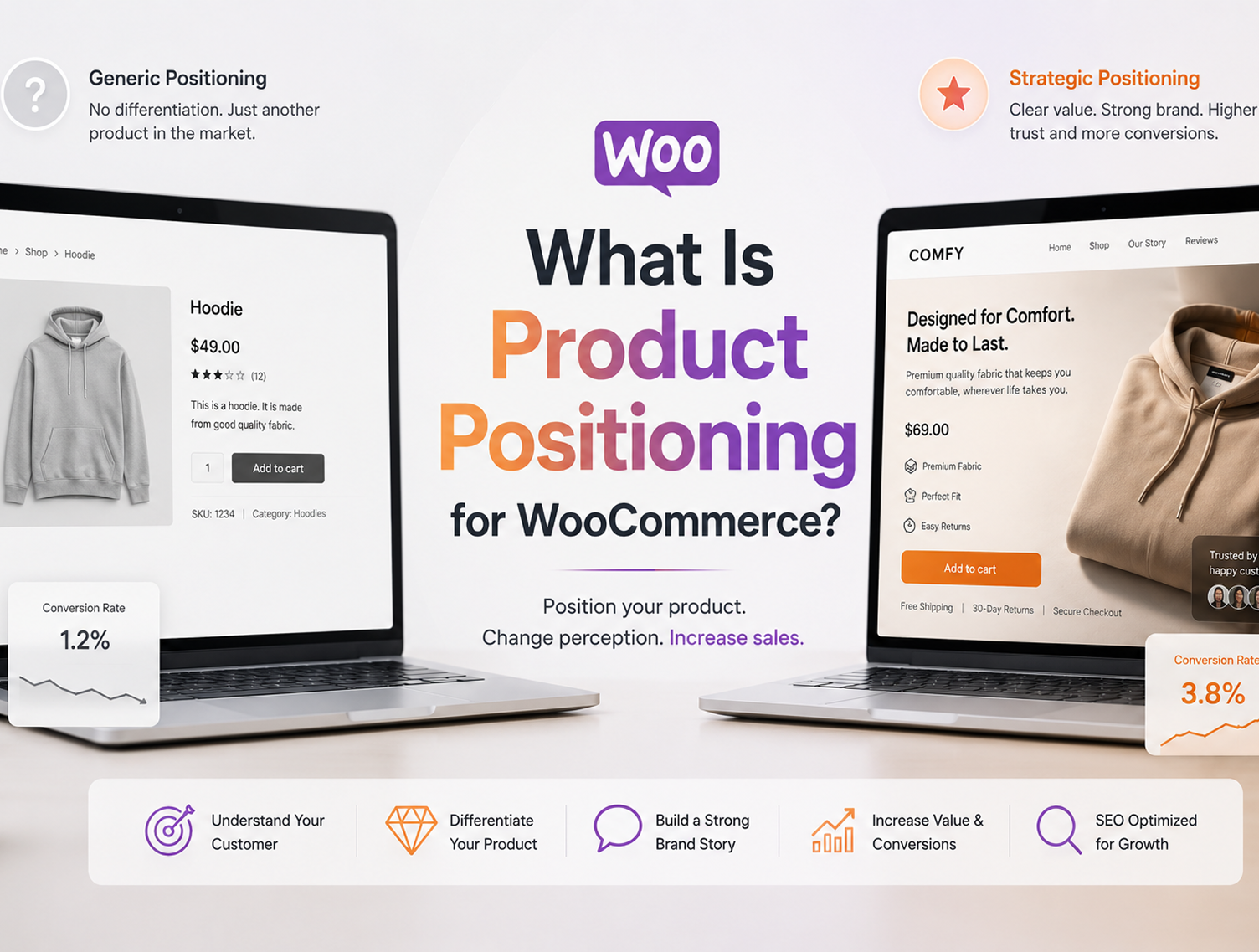
Two WooCommerce stores. Same product. Same price. One sells out. One gets ignored. Here’s the difference.
Picture this.
Two WooCommerce stores are both selling a handmade leather wallet. Same material. Same quality. Similar price point.
Store A has a product title like “Brown Leather Wallet.” The description? Three bullet points. Stock photo. No story. No soul.
Store B leads with: “Built for the long haul. Our wallets are hand-stitched in Rajasthan by third-generation craftsmen, and designed to look better at year ten than they did on day one.”
Same product. Completely different perception.
But still a gap, right? That’s product positioning for WooCommerce, and it’s the single most underused growth lever available to ecommerce store owners today.
What Is Product Positioning for WooCommerce?
Product positioning for WooCommerce is basically a strategic process, where you can decide how your product will be perceived by your target audience, and how it will be defined. So, once this is sorted, the three major questions of buyers will be answered as soon as they visit your product page:
Here’s what the numbers say:
- Why this product?
- Why this store?
- Why now?
And if your WooCommerce product page fails to answer those three questions within the first few seconds, the visitor leaves. Not because your product is bad- but because your positioning is invisible.
Most WooCommerce store owners focus obsessively on traffic. More ads. Better SEO. Lower prices. But the stores that win in 2026 aren’t winning on traffic alone. They’re winning because when a visitor arrives, the product page does the selling for them.
Product positioning is what makes that happen.
Why Commodity Thinking Is Killing WooCommerce Stores?
Here’s the hard truth: if your product page looks like every other product page in your category, you are a commodity. And commodities, they basically compete on price, a race to the bottom you can never truly win.
The ecommerce industry saturation in 2026 is at an all-time high. Thousands of WooCommerce stores sell nearly identical products. The stores that survive and grow are the ones that make customers feel something a plain product listing never could.
Think about what people are actually buying when they shop online. They’re not just buying a wallet, a yoga mat, or a coffee mug. They’re buying:
- A version of themselves they want to be
- The confidence that comes from making the right choice
- A story they can tell other people
WooCommerce product page optimization isn’t just about some flashy keywords & page speed. Rather, it’s about building a product page that a customer can see and think, “This was made for me.”
And that is the kind of shift from commodity to branded offer, and it starts with deliberate positioning.
The 5 Product Positioning Strategies (And Which One Fits You)
There’s no one-size-fits-all approach when it comes to the product; henceforth, in this section, we will be listing five core positioning strategies that high-performing WooCommerce stores are already using.
1. Value-Based Positioning
You offer more benefits per rupee spent. This works in price-conscious markets, but the risk is slipping into a commodity mindset. The key is to clearly articulate what the extra value is, not just claim it.
2. Premium Quality Positioning
You’re not the cheapest. You’re the best. This works when you can back it up with certifications, materials, craftsmanship, origin stories, and awards. Without proof, premium positioning falls flat.
3. Competitive Positioning
You directly compare yourself to alternatives and highlight your advantages. This works when you have clear, demonstrable benefits. Stay focused on your strengths rather than attacking competitors.
4. Category-Focused Positioning
You dominate a narrow niche. Instead of selling “running shoes,” you sell “running shoes for flat-footed long-distance runners.” Specificity beats generality every time in 2026.
5. Customer-Focused Positioning
You position yourself around a specific person’s identity or lifestyle. Your product isn’t just a product; it’s a reflection of who your customer is. This is where WooCommerce branding strategy and storytelling intersect most powerfully.
Pick one. Commit to it. Let it guide every word on your product page, every image you choose, and every review you showcase.
Building Your Unique Value Proposition (UVP) on WooCommerce
Your UVP is the spine of your product positioning. It answers: “Why should I buy this from you, specifically?”
Here’s what a good UVP looks like in practice on a WooCommerce product page:
Weak UVP: “High-quality leather wallet. Durable and stylish.”
Strong UVP: “Hand-stitched by master craftsmen in Rajasthan. Built to develop a richer patina with age, because the best wallets shouldn’t look new forever.”
But what’s the difference between them?
Specificity, proof, and emotional resonance.
Three rules for writing a strong UVP on WooCommerce:
Rule 1- Be Specific About Outcomes, Not Features.
A feature is “full-grain leather.” An outcome is “still looks great after five years of daily use.” Customers buy outcomes. Always translate features into the real-world results your buyer actually cares about.
Rule 2- Make It Scannable.
In 2026, 68% of shoppers still choose trust over price, but trust has to be established in seconds. Your UVP should be readable at a glance: a headline, a supporting line, and 3–4 proof points. No paragraphs of marketing copy above the fold.
Rule 3- Back every claim immediately.
42% of shoppers abandon a purchase when claims have no proof. If you say “best-in-class durability,” show a video, a test result, or a customer story that demonstrates it. Claims without evidence are just noise.
How to Optimize Your WooCommerce Product Page for Positioning?
A great positioning strategy is worthless if your product page doesn’t execute it. Here’s how to make your WooCommerce product page optimization work in service of your brand story:
Lead With Identity, Not Inventory
Your product title and hero section should immediately signal who this is for. Not just what the product is.
Instead of: Stainless Steel Water Bottle 750ml
Try: The Everyday Carry Bottle- Leak-proof, lightweight, and built for people who actually move.
The second version tells a story. It creates belonging. It positions.
Write Descriptions That Sell Outcomes
This is the heart of WooCommerce product description tips: stop describing your product and start describing your customer’s life with your product.
Structure every product description like this:
- The Situation- What problem or desire brought them here?
- The Product as Solution- What does it do, specifically?
- The Outcome- How does their life look after using it?
- The Proof- A review, stat, or credential that validates the claim
This isn’t fluff. It’s the difference between a page that converts and one that doesn’t.
Use Scenario-Based Sections
One of the most powerful and most ignored WooCommerce product page optimization tactics is structuring your description around use cases:
- Best for: Daily commuters/home office setups/gifting
- Works perfectly with: [complementary products]
- Not the right fit if: [honest caveat — this builds enormous trust]
When you’re honest about who the product isn’t for, buyers trust everything else you say. And as a bonus, this structure makes your page far more likely to be cited in AI-generated search results.
Add Social Proof Strategically
Reviews and testimonials aren’t just trust signals- they’re positioning amplifiers. Place them at the precise moment a buyer’s doubt peaks: right below the price, and again near the Add to Cart button.
Video testimonials are especially powerful in 2026 because they signal authenticity in an era where AI-generated reviews are everywhere. A real face, a real voice, a real result, that’s differentiation money can’t easily replicate.
WooCommerce Branding Strategy: The Page Beyond the Product
Your product page doesn’t exist in isolation. Every touchpoint- your images, your fonts, your copy tone, your packaging notes is either reinforcing your positioning or undermining it.
WooCommerce branding strategy in 2026 means asking: “If someone could only see this product page, would they understand exactly who we are and who we’re for?”
Here’s what that looks like in practice:
- Imagery tells the story before words do. Lifestyle photography that shows your product in use in contexts your customer recognises converts dramatically better than flat white-background shots alone.
- Tone of voice is positioning made audible. A brand selling premium outdoor gear should sound different from one selling handmade children’s toys. Consistency in voice builds the feeling that there’s a real, caring person behind the store — not just a product catalogue
- About Us & Brand Story- the pages most WooCommerce stores treat as afterthoughts are often the deciding factor for first-time buyers. People buy from people they trust. Give them a reason to trust you.
WooCommerce SEO 2026 & Product Schema: Positioning for AI Search
Here’s where product positioning for WooCommerce gets modern.
In 2026, your product page doesn’t just need to convince human visitors; it needs to be understood by AI systems that decide whether to recommend you. WooCommerce SEO 2026 is no longer just about keywords. It’s about structured clarity.
WooCommerce product schema structured data that tells Google’s AI exactly what your product is, who it’s for, what it costs, and what customers think of it is now a positioning tool, not just a technical checkbox.
When your schema includes specific attributes (material, use case, dimensions, compatibility), AI systems can confidently match your product to buyer queries and surface it in AI Overviews and recommendations. Vague product data gets skipped. Specific, structured product data gets cited.
For WooCommerce conversion rate optimization, combine your brand positioning with technical precision:
- Product schema with price, availability, ratings, and key attributes
- FAQ sections on category pages that answer real buyer questions
- Product descriptions that lead with factual specifics, then benefits, then brand story
- Consistent data across your WooCommerce store, Google Merchant Center, and any marketplace listings
The stores winning AI search in 2026 aren’t winning because they gamed the system. They’re winning because their positioning is so clear and their product data so complete that AI has everything it needs to confidently recommend them.
How to Stand Out on WooCommerce: The Checklist
Save this. Apply it to your top 10 product pages first, then work through the rest of your catalog:
- Your product title signals who the product is for, not just what it is
- Your UVP is visible above the fold headline + supporting line + proof
- Product description follows: Situation → Product → Outcome → Proof
- Scenario-based sections clarify best use cases and honest limitations
- Lifestyle photography shows the product in the context in which your customer lives
- Social proof (ideally video) is placed at key decision points on the page
- Brand voice is consistent across all pages, product, about, and category
- WooCommerce product schema is complete with all key attributes
- FAQ section added to top category pages
- Product data is consistent across all channels (store, GMC, marketplaces)
- The About Us page tells a real story, people, mission, and proof of expertise
This Is the Work That Compounds
Traffic tactics produce spikes. Product positioning for WooCommerce produces compounding growth.
When your positioning is right, every visitor who lands on your page is more likely to buy. Every customer who buys is more likely to come back. Every review they leave reinforces your positioning for the next buyer.
It’s a flywheel, and it starts with one decision: to stop treating your products like listings and start treating them like branded offers.
The stores that made that shift are the ones outperforming their categories in 2026. Not because they have more traffic. Because they have more meaning, and meaning is the one thing no competitor can copy overnight.
Ready to Build a WooCommerce Store That Positions, Converts, and Grows?
Getting product positioning right on WooCommerce takes more than good copy. It takes the right page structure, the right schema, the right design decisions, all working together in service of a clear brand story.
That’s exactly what we specialise in at Dynamic Dreamz.
We’re a WooCommerce and WordPress development agency based in Surat, helping ecommerce brands build stores that don’t just look good but position, convert, and grow in the most competitive ecommerce landscape we’ve ever seen.
If you’re ready to turn your WooCommerce product pages from commodity listings into branded offers your customers can’t ignore, let’s talk.
FAQ
What is product positioning for WooCommerce?
It’s the strategy of defining how your product is perceived by customers relative to competitors through your WooCommerce store. It shapes your copy, visuals, and page structure so visitors immediately understand why your product is the right choice for them.
Why does product positioning matter for WooCommerce stores?
Without it, your store becomes a commodity competing only on price. Strong positioning helps you charge more, convert better, and build loyalty — without spending more on ads.
What is a Unique Value Proposition (UVP) and do I need one?
A UVP is a clear statement that tells customers what they get, why it matters, and why they should choose you. Yes — every WooCommerce product page needs one, placed above the fold and backed by specific proof, not vague claims.
How does product positioning improve WooCommerce conversion rates?
When your page clearly answers “why this product, why this store, why now” — visitors don’t need to leave and compare. Clear positioning reduces friction and makes the buying decision feel easy and confident.
Does product positioning help with WooCommerce SEO in 2026?
Yes. Outcome-focused descriptions naturally include long-tail keywords. FAQ sections boost AI search visibility. Complete product schema builds trust with Google. Good positioning and good SEO are the same strategy in 2026.
What role does WooCommerce product schema play in positioning?
Schema tells Google’s AI exactly what your product is, who it’s for, and why it’s trustworthy. In 2026, a complete and attribute-rich schema is the difference between being recommended by AI or being skipped entirely.
How do I start improving product positioning on my WooCommerce store?
Start with your top 5 products. Rewrite each title to signal who it’s for, restructure descriptions around outcome and proof, add lifestyle imagery, and place reviews at key decision points. Then scale across your catalog.
Does Dynamic Dreamz help with WooCommerce product positioning?
Yes. We help WooCommerce store owners build product pages that are strategically positioned, technically optimised, and designed to convert. Get in touch at dynamicdreamz.com