
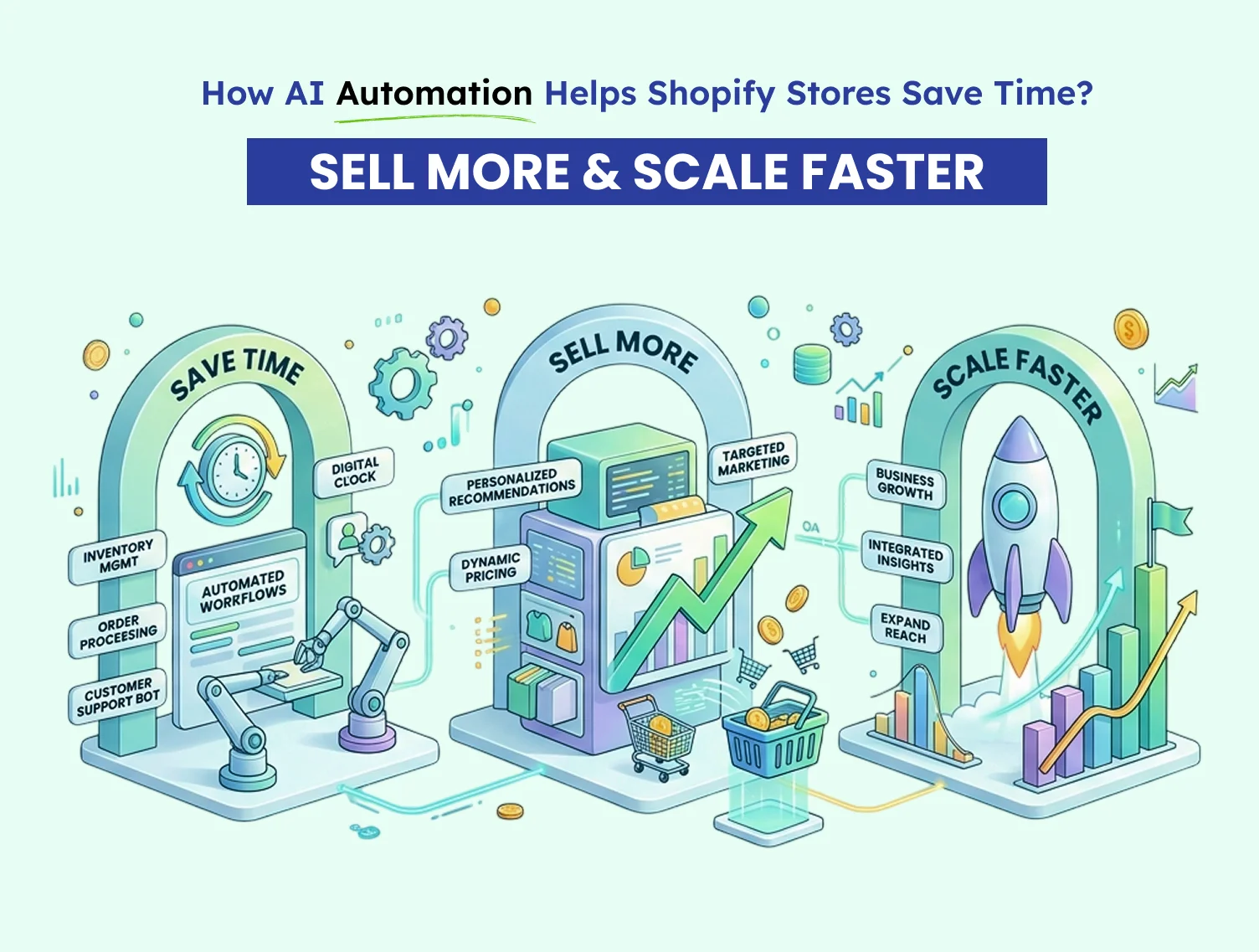
Running a Shopify store in 2026 is really great, until reality hits you hard! Because today at your store, you have to manage orders, respond to customer queries, update product listings, track inventory, and try to figure out why your conversion rate dipped yesterday!
Sound familiar? If yes, then you’re not the only one going through that cycle. It’s more likely that most Shopify store owners will hit a point where the manual workload starts pulling them away from the bigger picture. And that is really the exact problem today, that AI automation for Shopify stores is designed to solve.
So, it’s not about replacing the human, but about automating the repetitive, time-consuming tasks- just so you can entirely focus the energy on what actually moves the needle: strategy, creativity & building customer relationships that last.
Henceforth, through the medium of this blog, we are gonna help you see how AI helps Shopify stores thrive, the tools you should really know about, and how you can start putting this to work for your store today.
What Is AI Automation for Shopify Stores, And Why Does It Matter Now?
AI automation for Shopify stores is about utilizing artificial intelligence-powered tools and logic-based workflows, with which you can handle daily tasks much better. Moreover, it also rules out manual labor from your workflow.
But why does it all suddenly matter in 2026? This ecommerce world has never been this competitive, because shoppers nowadays are expecting personalized experiences, quick responses, and seamless interactions, and that is why the need for AI is more than ever.
So, that is why Shopify is investing heavily in native AI tools, so they can easily automate Shopify store with AI. And with Shopify Magic, Shopify Sidekick, and Shopify Flow, the platform has made AI automation accessible to every store owner, no developer required, no complicated integrations, and no steep learning curve.
Let’s dig into the specifics.
7 Powerful Ways AI Automation Helps Shopify Stores
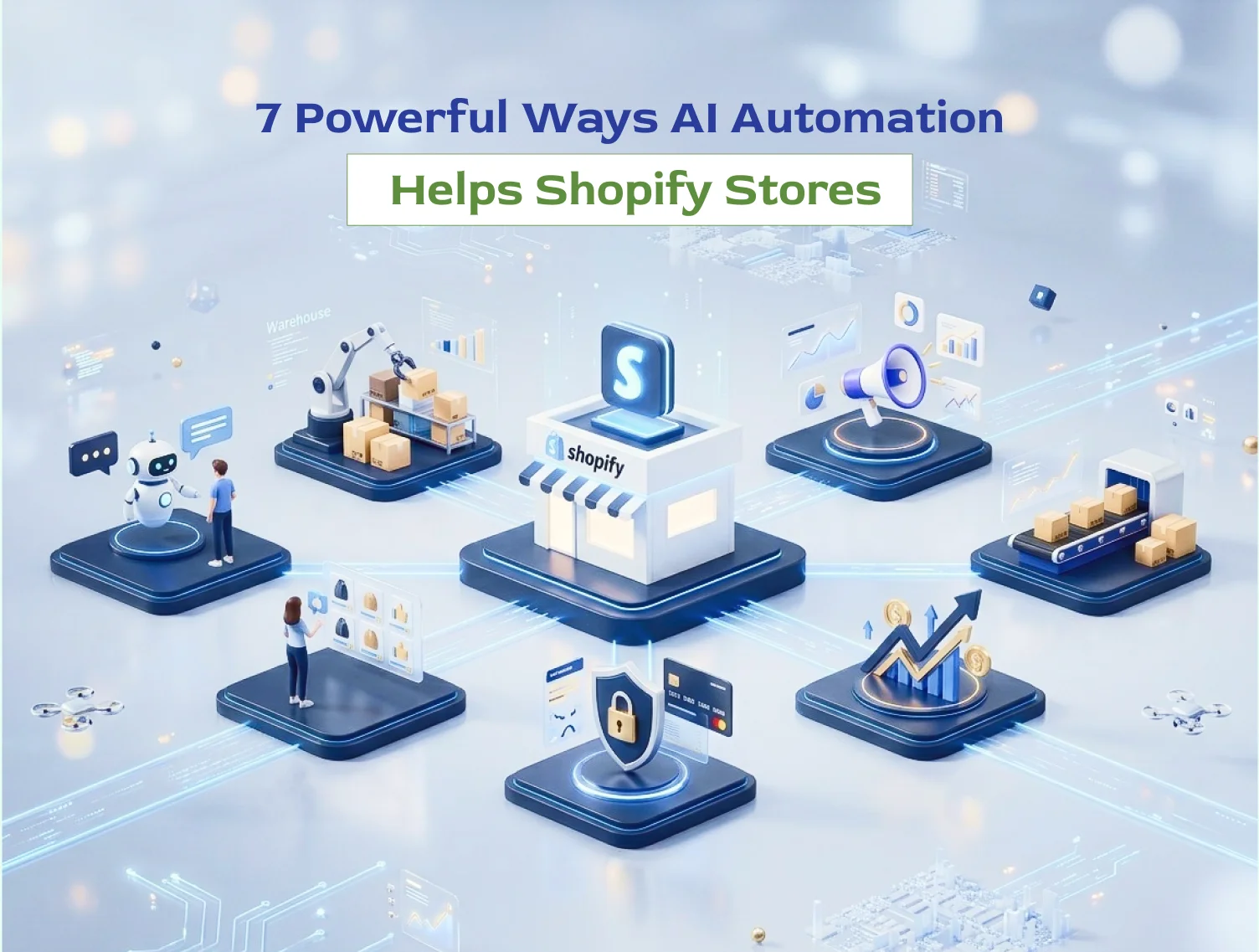
Let’s have a look at the 7 ultimate AI automations that can help Shopify stores perform really well.
1. Writing Product Content That Actually Converts
One of the most time-draining tasks for any store owner is writing product descriptions. If you have 50, 100, or 500 products, it’s a full-time job on its own, and doing it badly means lost SEO rankings and lower conversions.
Shopify Magic changes the game here. Feed it a few keywords about your product, and it generates compelling, SEO-optimized product descriptions in seconds. You still add your brand voice and tweak the final version, but the blank page problem? Gone.
Shopify Magic also helps with email subject lines, blog post ideas, and ad copy, making it one of the most versatile AI tools for Shopify 2026 has to offer.
2. Recovering Lost Revenue from Abandoned Carts
Here’s a number that should get your attention: nearly 70% of online shopping carts are abandoned. That’s a massive chunk of potential revenue just walking out the door.
AI-powered abandoned cart flows can detect exactly when a customer drops off, analyze their behavior, and automatically send them a personalized recovery email or SMS at the optimal time. The message, timing, and even the discount offered can all be personalized based on what the customer browsed and how close they got to checkout.
This is one of the clearest examples of how to use AI to grow a Shopify store; you’re recovering revenue that would have otherwise been lost, completely on autopilot.
3. Smarter Inventory Management & Demand Forecasting
Inventory mismanagement is one of the leading causes of lost profit in ecommerce. Either you’re sitting on too much stock, or you’re running out of your best-sellers at the worst possible time.
AI tools analyze your historical sales data, seasonal trends, and demand patterns to forecast what you’ll need and when. Pair that with Shopify Flow, and you can set up automated workflows that send restock alerts, notify suppliers, and even pause ads for out-of-stock products, all without you lifting a finger.
The result? Fewer stockouts, less dead inventory, and a healthier cash flow.
4. Personalizing the Shopping Experience at Scale
Think about the last time you got a “Recommended For You” section that actually felt like it was made for you. That feeling of being understood is what keeps customers coming back, and AI makes it possible at scale.
When you automate your Shopify store with AI, and know how to use AI to grow Shopify store, you can serve personalized product recommendations based on each customer’s browsing history, purchase behavior, and preferences. Customers who see relevant products are more likely to buy, more likely to add more to their cart, and more likely to return.
Beyond product recommendations, AI can also personalize email campaigns, homepage banners, and promotional offers, creating a unique experience for each visitor without any extra manual work on your end.
5. 24/7 Customer Support Without a Full-Time Team
Your customers shop at midnight. They need answers on Sunday mornings. They want to know where their order is at 6 AM before they leave for work. If your support team isn’t available, that frustration turns into bad reviews and lost trust.
AI-powered chatbots integrated with your Shopify store can handle the most common queries, order status, shipping timelines, return policies, and product information, instantly and accurately, around the clock. Your human support team only gets involved when a situation genuinely needs a personal touch.
This dramatically reduces support costs while actually improving the customer experience. That’s one of the most underrated benefits of AI for ecommerce store owners.
6. Fraud Detection That Protects Your Revenue
Chargebacks and fraudulent orders are a silent drain on ecommerce businesses. By the time you realize something’s off, the damage is already done.
Shopify’s built-in fraud analysis uses machine learning to evaluate every order in real time, flagging suspicious patterns like mismatched billing details, unusual purchase volumes, or high-risk IP addresses. You can then review flagged orders before fulfilling them, saving you money and time.
7. Automating Marketing Campaigns & Customer Segmentation
Sending the same email blast to your entire list in 2026 is like using a megaphone in a library: loud, annoying, and ineffective. AI changes this by automatically segmenting your customers based on behavior, purchase history, location, and lifetime value.
You can set up flows that automatically send a win-back campaign to customers who haven’t purchased in 60 days, a VIP reward email to your top spenders, or a first-purchase thank you sequence for new customers. All triggered automatically, all deeply personalized.
This is one of the most scalable Shopify AI automation tools available today, and it pays for itself very quickly.
Shopify Sidekick: The AI Feature That Changes Everything
If there’s one Shopify AI feature that store owners are genuinely excited about right now, it’s Shopify Sidekick. Built directly into the Shopify admin, Sidekick works like a knowledgeable business assistant that understands your store, your data, your products, and your customers.
Instead of clicking through menus and dashboards to find what you need, you just ask:
- “What were my top 5 products by revenue last quarter?”
- “Create a discount code for 15% off for customers who haven’t ordered in 90 days.”
- “Set up a workflow to automatically tag high-value orders above ₹15,000.”
- “Which products have the highest return rate this month?”
Sidekick understands plain English instructions and carries them out within your store environment. No developer. No plugin. No learning curve. Just a smarter, faster way to manage your business.
Shopify Sidekick AI features represent a genuine shift in how store owners interact with their data, and it’s only going to get more powerful from here.
The Real-World Benefits of AI for Ecommerce Store Owners
Beyond the feature lists and use cases, let’s get to understand what the very benefits of AI for ecommerce store owners are;
- You reclaim hours every week that were previously spent on manual, repetitive tasks.
- Your store operates and responds to customers even when you’re offline
- Conversion rates improve because the experience feels tailored, not generic
- Your team (however big or small) focuses only on high-value, creative work
- You scale your store without having to proportionally scale your headcount
- Data-driven decisions replace gut-feel guesses, because AI surfaces the right insights
So, no matter if you’re a solo founder managing everything by yourself or a growing team seeking options to scale your operations, you just have to learn how to use AI to grow your Shopify store. Because it’s inevitably one of the highest-leverage investments you can make right now in 2026.
How to Get Started: Automate Your Shopify Store with AI
Now, when you know all the benefits of this AI automation, and are wondering where you can begin, you should have a look at a practical starting point that is already working for most Shopify stores:
- Start with Shopify Magic, use it for product descriptions and email subject lines. It’s free, built-in, and immediately useful.
- Set up your first Shopify Flow, try a simple workflow like auto-tagging orders above a certain value, or sending a low-stock alert.
- Activate abandoned cart recovery, if you haven’t already; this single automation can recover significant lost revenue.
- Explore an AI chatbot, tools like Tidio or Gorgias, integrate seamlessly with Shopify and can handle your most common support queries.
- Talk to a Shopify expert. Sometimes, a few hours with the right partner can save you weeks of trial and error.
So, the key here is to start small, keep measuring the results, and build from there. So, you don’t have to automate everything in just one night, because simply put, one or two well-set-up workflows can make a meaningful difference to your daily operations.
Ready to Automate Your Shopify Store?
Because at Dynamic Dreamz, we’re a Shopify Premier Partner with hands-on experience that can help you out in setting up a store that is built to grow. So, whether you’re just starting from scratch or looking to level up an existing store, we can help you make it happen.
Explore our Shopify services and let’s build something smart together.
FAQ
Do I need technical knowledge to use AI automation tools for Shopify?
No. The best Shopify AI automation tools in 2026, which include Shopify Magic, Sidekick, and Flow, are designed in a way that even non-technical store owners can use easily.
Is AI automation only useful for large Shopify stores?
Not at all. In fact, even small and mid-size stores can expect biggest relative impact, because the time saved is a larger proportion of their available capacity. So, you simply don’t need a big team or a big budget to benefit from how AI helps Shopify stores grow.
What is the difference between Shopify Flow and Shopify Magic?
Shopify Flow is a workflow automation tool with which you can easily create rule-based automations like
- “If order value is above X, tag it as VIP” or
- “If inventory drops below 10, send a restock alert.”
Shopify Magic, on the other hand, is an AI content generation tool with which you can quite easily create content, product descriptions, email subject lines, and more.
But both of them are an integral part of Shopify’s growing AI automation toolkit & work best when used together.
What are the best AI tools for Shopify in 2026?
The most impactful AI tools for Shopify 2026 include;
- Shopify Magic (content generation),
- Shopify Sidekick (conversational AI assistant),
- Shopify Flow (workflow automation),
- Klaviyo (AI-powered email marketing),
- Gorgias (AI customer support), and
- Various AI-powered product recommendation apps are available in the Shopify App Store.
However, the right stack depends on your store’s size, niche, and biggest pain points.